When Do Advanced Driver Assistance System Failures Qualify As A Lemon?
This article explains when recurring Advanced Driver Assistance System (ADAS) failures may qualify for lemon law protection. It covers serious safety defects, repeated unsuccessful repair attempts, extended vehicle downtime, and the importance of maintaining proper documentation. It also explains how a lemon law lawyer can help vehicle owners evaluate potential claims and understand their legal options.
By Vishal
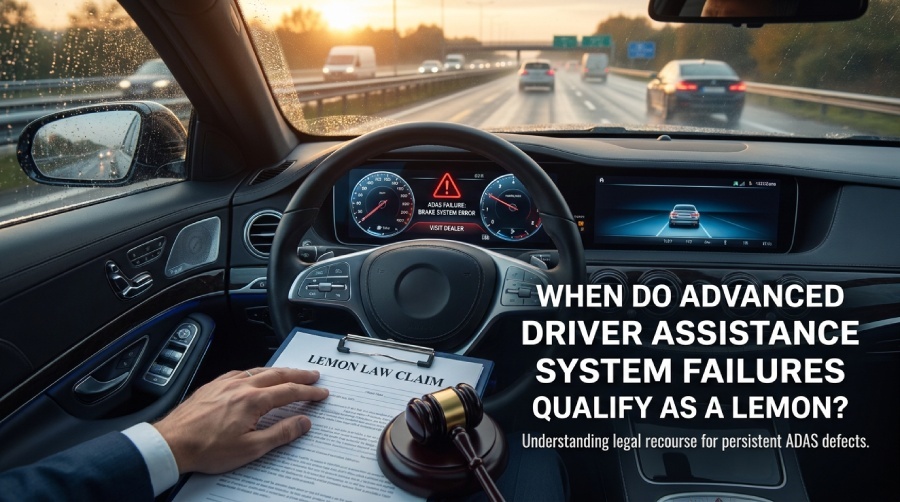
Advanced Driver Assistance Systems (ADAS) are designed to make driving safer by helping drivers detect potential hazards, maintain safe distances, and respond to changing road conditions. Features such as automatic emergency braking, lane departure warnings, adaptive cruise control, blind-spot monitoring, and collision avoidance have become increasingly common in modern vehicles.
However, these technologies do not always function as intended. Persistent warning messages, unexpected braking, inaccurate sensor readings, and repeated system malfunctions can affect a vehicle's safety, reliability, and overall performance.
When these problems continue despite multiple repair attempts, vehicle owners may wonder whether their car qualifies as a lemon. A lemon law lawyer can help evaluate recurring ADAS malfunctions and determine whether they meet the applicable legal requirements. Not every ADAS malfunction automatically qualifies for lemon law protection. However, a recurring defect that substantially affects vehicle safety, use, or value may qualify for legal protection, depending on the applicable law and the circumstances of the case.
Understanding which ADAS failures may qualify, how repair attempts are evaluated, and what documentation matters can help vehicle owners determine their next steps.
What Are Advanced Driver Assistance System (ADAS) Failures?
ADAS failures occur when driver assistance technologies do not operate according to their intended functions. These systems rely on cameras, radar sensors, ultrasonic sensors, software, and electronic control units to monitor the vehicle's surroundings and provide assistance.
A malfunction can affect one feature or several connected systems.
Common ADAS-related problems include:
Automatic Emergency Braking (AEB) Failure: The system fails to detect an obstacle or applies the brakes unexpectedly.
Lane Keeping Assist Malfunction: The vehicle does not provide appropriate steering assistance or incorrectly detects lane markings.
Adaptive Cruise Control Problems: The system fails to maintain a consistent following distance or unexpectedly accelerates or decelerates.
Blind-Spot Monitoring Failure: The system does not detect vehicles in adjacent lanes or provides inaccurate warnings.
Forward Collision Warning Errors: The vehicle displays repeated false alerts or fails to warn the driver about potential collisions.
Parking Assistance Malfunctions: Sensors provide inaccurate distance readings or fail to detect nearby objects.
Although some issues may result from temporary sensor obstructions or environmental conditions, repeated malfunctions can indicate an underlying manufacturing or software defect.
When Can ADAS Failures Qualify as a Lemon?
An ADAS problem may qualify under applicable lemon law protections when it involves a defect covered by the law and the manufacturer or its authorized repair network cannot successfully resolve it within the required repair opportunities or time period.
The exact eligibility requirements vary by jurisdiction, vehicle type, warranty coverage, and applicable legal provisions.
Several factors can help determine whether an ADAS-related problem deserves further legal evaluation.
1. The Defect Substantially Affects Vehicle Safety
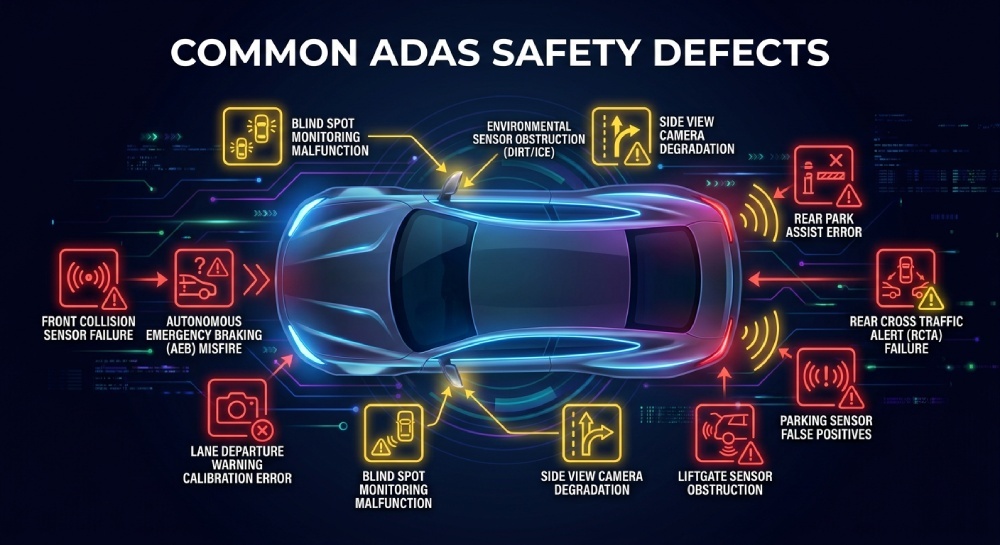
Safety-related ADAS failures can be particularly concerning because these systems are designed to help prevent collisions and reduce driving risks.
For example, a vehicle that repeatedly applies emergency braking without an obstacle may create dangerous driving conditions. Similarly, a malfunctioning lane departure prevention system may fail to provide expected assistance.
Potentially significant safety-related defects include:
Automatic braking activates unexpectedly.
Collision warning systems failing to detect approaching hazards.
Steering assistance malfunctioning during normal driving.
Adaptive cruise control failing to respond appropriately to changing traffic conditions.
Blind-spot monitoring repeatedly failed to identify nearby vehicles.
A defect does not necessarily need to cause an accident to raise a legitimate safety concern. However, its actual impact and the applicable legal requirements must be considered.
2. The Problem Continues After Multiple Repair Attempts
Repeated unsuccessful repair attempts are another important consideration.
A manufacturer may inspect the vehicle, replace sensors, update software, recalibrate cameras, or perform other diagnostic procedures. However, if the same malfunction continues after these efforts, the underlying defect may remain unresolved.
For example, a vehicle owner may experience repeated forward collision warning failures. The dealership updates the software and recalibrates the front camera, but the warning continues appearing during normal driving.
In such situations, repair records can help establish:
How many times the vehicle was presented for the same issue.
Which diagnostic procedures were performed.
Whether components or software were replaced.
Whether the malfunction returned after repairs.
Whether the dealership acknowledged an unresolved problem.
The number of required repair attempts depends on the applicable lemon law. Some laws also provide different standards for serious safety defects.
3. The Vehicle Remains Out of Service for an Extended Period
The time a vehicle spends undergoing repairs can also affect lemon law eligibility.
Even when the manufacturer makes repeated attempts to correct an ADAS malfunction, the vehicle may remain unavailable for an extended period because of diagnostic delays, replacement parts, software issues, or repeated repair visits.
For example, a vehicle owner may have to leave their car at a dealership multiple times because the adaptive cruise control system repeatedly stops functioning.
Important records include:
Dates when the vehicle entered and left the repair facility.
The total number of days the vehicle remained unavailable.
Repair orders and service invoices.
Parts replacement and diagnostic records.
Any communication explaining repair delays.
Depending on the applicable law, an extended period out of service may contribute to a lemon law claim.
Which ADAS Problems May Be Considered Serious Defects?
Not every warning light or temporary system interruption indicates a qualifying manufacturing defect. Some ADAS features may stop working because of dirty sensors, heavy rain, poor visibility, damaged camera lenses, or blocked radar equipment.
However, persistent problems that continue under normal operating conditions deserve closer attention.
Software and Calibration Failures
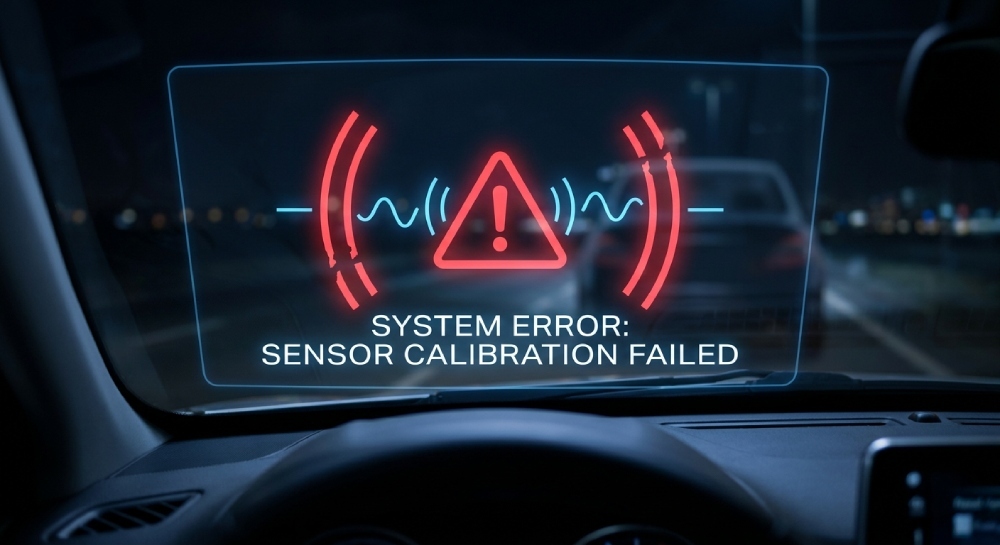
Modern driver assistance systems depend heavily on software and accurate sensor calibration.
A software update may be intended to correct a malfunction, but it does not always resolve the underlying issue. Similarly, incorrect camera or radar calibration can affect how the vehicle identifies surrounding objects.
Recurring software errors, failed updates, or repeated calibration problems may indicate a defect requiring further investigation.
Unexpected Braking or Steering Assistance
Unintended braking and steering behavior can significantly affect vehicle operation.
Examples include:
Emergency braking activating without an apparent hazard.
Lane keeping assistance applying unexpected steering corrections.
Adaptive cruise control suddenly reduces speed.
Steering assistance failing to respond consistently.
When these problems repeatedly occur, they may raise substantial safety and reliability concerns.
Repeated Sensor and Camera Malfunctions
ADAS technologies depend on accurate information from cameras, radar, and other sensors.
A defective component may cause the vehicle to display persistent warnings, misidentify objects, or disable important driver assistance features.
If sensor replacement, recalibration, or other repairs fail to resolve the problem, the recurring malfunction may warrant a closer legal review.
What Evidence Can Help Support an ADAS-Related Lemon Law Claim?
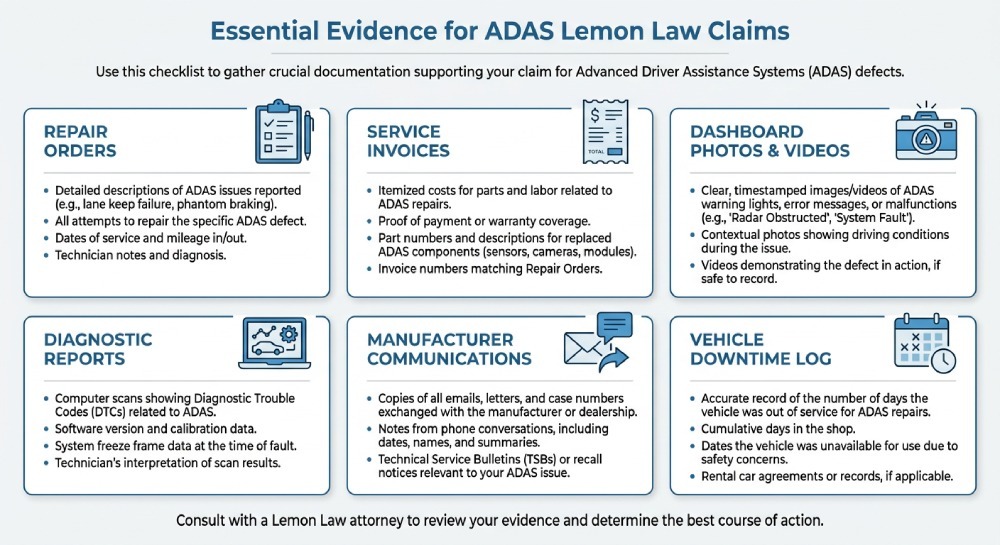
Documentation is essential when evaluating whether a vehicle has a qualifying defect.
Vehicle owners should maintain detailed records of every malfunction and repair attempt.
These records can help demonstrate the defect's frequency, severity, and impact on vehicle use.
Important evidence may include:
Repair Orders: Documents showing reported problems, dealership findings, and completed repairs.
Service Invoices: Records of parts replacements, software updates, and diagnostic work.
Dashboard Warning Photos: Images or videos showing recurring ADAS warning messages.
Diagnostic Reports: Technical findings related to cameras, radar sensors, control modules, and software.
Manufacturer Communications: Emails, letters, or case numbers related to unresolved defects.
Vehicle Downtime Records: Information showing how long the vehicle remained unavailable for repairs.
It is also helpful to maintain a written timeline describing when the malfunction first appeared, how frequently it occurred, and whether it returned after repairs.
Consistent documentation can make it easier to evaluate the vehicle's repair history and determine whether the defect meets applicable legal requirements.
What Should Vehicle Owners Do When ADAS Problems Keep Returning?
If an ADAS malfunction continues despite repair attempts, vehicle owners should take practical steps to protect their interests.
Report the Problem Clearly
Describe the malfunction to the dealership in specific terms. Explain when it occurs, which features are affected, and whether it creates unexpected vehicle behavior.
Avoid describing recurring safety issues as minor warning light problems.
Request Copies of All Repair Records
Ask for a copy of every repair order, diagnostic report, and service invoice. Make sure the reported concern is accurately documented, even when the dealership cannot reproduce the problem.
Follow Manufacturer and Dealership Instructions
Follow appropriate service recommendations and avoid attempting unauthorized modifications that could interfere with vehicle safety systems or warranty coverage.
Seek Legal Guidance
If the defect continues after repair attempts, consider consulting an attorney familiar with lemon law claims. A legal professional can review the vehicle's warranty, repair history, downtime, and applicable eligibility requirements.
Can an ADAS Software Defect Qualify Even Without a Physical Component Failure?
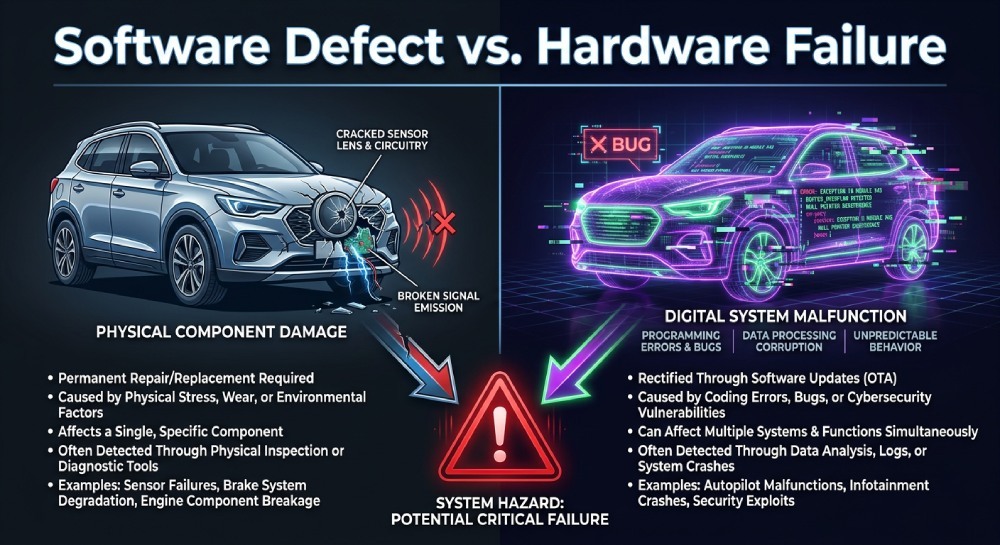
Yes, a software-related problem may potentially qualify even when no physical component is broken.
Modern vehicles rely on software to process sensor information, coordinate braking assistance, detect nearby objects, and support steering functions. A programming error or software malfunction can interfere with these operations just as a defective physical component can.
For example, a vehicle may repeatedly display false collision warnings because its driver assistance software incorrectly interprets sensor data.
The important consideration is not simply whether the defect involves hardware or software. Instead, the evaluation generally focuses on whether the problem is covered by applicable law and substantially affects the vehicle's use, safety, or value.
Final Thoughts
Advanced Driver Assistance Systems play an increasingly important role in modern vehicle safety. However, recurring problems involving automatic emergency braking, adaptive cruise control, lane keeping assistance, collision warnings, and other features can create serious concerns when manufacturers cannot resolve them.
An ADAS malfunction does not automatically make a vehicle a lemon. Nevertheless, persistent defects that substantially affect safety, use, or value may qualify for protection under applicable lemon laws.
Maintaining complete repair records, documenting recurring warning messages, and understanding the relevant legal requirements can help vehicle owners determine whether they have a potential claim. When repeated repairs fail to resolve an ADAS problem, seeking qualified legal guidance can help clarify available options.
- ADASFailures
- AdvancedDriverAssistanceSystems
- LemonLaw
- LemonLawLawyer
- VehicleSafetyDefects
- RecurringVehicleDefects
- CarRepairIssues
- SoftwareDefects
- VehicleWarranty
- LemonLawClaims
- ADASMalfunctions
- AutomotiveSafety
Think you've got a lemon?
Compare your situation to your state's requirements — and connect with a vetted lemon-law attorney for a free case review.