Can Your Car Qualify as a Lemon if the Warning Light Disappears Before Every Repair Appointment?
A car may still qualify as a lemon even if its warning light disappears before every repair appointment. Intermittent warning lights can indicate underlying mechanical, electrical, or safety-related defects that remain unresolved. Keeping detailed records, documenting symptoms, and obtaining written dealership repair reports can help establish a potential lemon law claim. Eligibility depends on the applicable state law, defect severity, repair attempts, and warranty requirements.
By Vishal
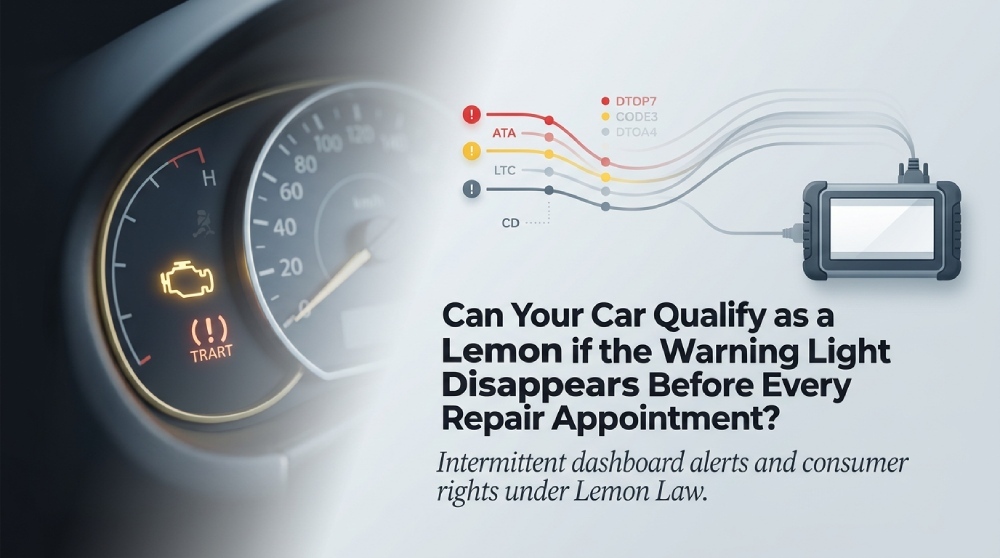
A dashboard warning light can be frustrating, especially when it repeatedly appears while driving but disappears before you reach the repair shop. You may notice an engine warning, transmission alert, or other electronic issue, only to have the vehicle appear completely normal when a technician examines it. Even after multiple dealership visits, the underlying problem may remain unresolved.
This situation raises an important question: Can your car qualify as a lemon if the warning light disappears before every repair appointment? In many cases, yes. A warning light that disappears does not automatically mean your vehicle is free from defects or that you lose your consumer protection rights. However, eligibility depends on the applicable state lemon law, the nature of the defect, the repair history, and how the problem affects the vehicle's use, value, or safety.
For example, a driver in New York might experience a recurring engine warning light that disappears after restarting the car. If the issue continues despite several repair attempts, the driver may have grounds to explore a lemon law claim.
Can a Car Qualify as a Lemon When the Warning Light Disappears?
Yes, a vehicle may qualify as a lemon even when its warning light disappears before a repair appointment. The important consideration is whether an underlying defect exists and whether the manufacturer or its authorized dealership has had a reasonable opportunity to repair it.
Modern vehicles use electronic control systems and onboard diagnostics to monitor engine performance, emissions, transmission operation, and other components. Some faults occur intermittently, meaning they may not appear during every drive.
A warning light might disappear because the problem temporarily stops occurring, the vehicle's computer no longer detects the condition, or the issue requires specific driving conditions to reappear. In some cases, diagnostic trouble codes may remain stored in the vehicle's computer even after the dashboard light turns off.
Therefore, the absence of an illuminated warning light during an inspection does not necessarily establish that the vehicle is operating correctly.
Why Intermittent Warning Lights Can Indicate a Serious Problem
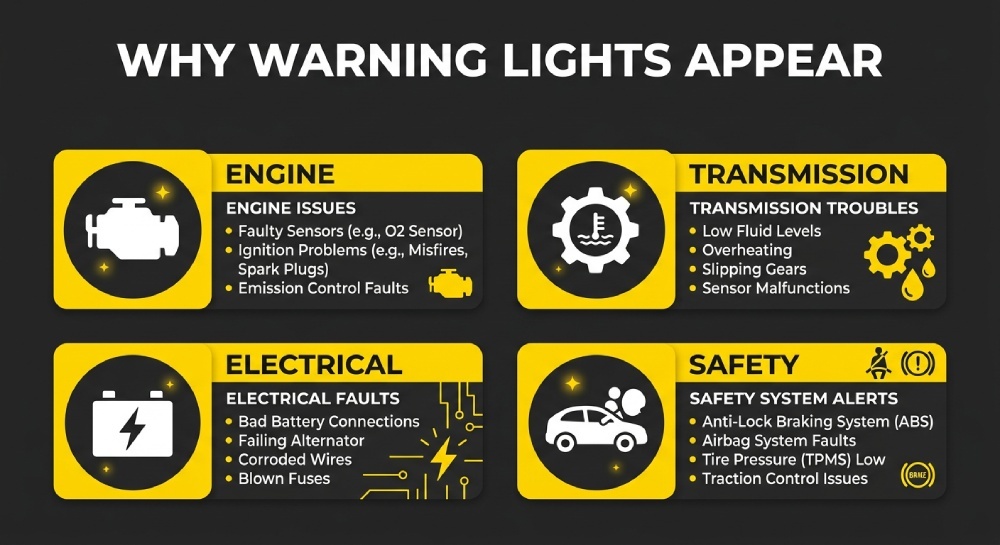
Intermittent warning lights can be associated with different vehicle problems, including:
Engine performance issues: Misfires, faulty sensors, or fuel system irregularities may trigger an engine warning light.
Transmission problems: Electronic or mechanical faults may cause occasional warning messages, delayed shifting, or unusual vehicle behavior.
Electrical system faults: Loose connections, damaged wiring, or inconsistent sensor signals may produce recurring alerts.
Safety-related defects: Certain braking, steering, or airbag warnings may indicate conditions that require prompt professional attention.
Not every warning light indicates a major defect. However, a recurring alert should not be ignored simply because it disappears. The seriousness of the underlying condition and its impact on the vehicle are important when evaluating a potential lemon law claim.
How Lemon Laws Evaluate Recurring Vehicle Problems
Lemon laws generally protect eligible consumers who purchase or lease vehicles with qualifying defects that manufacturers cannot repair within the requirements established by applicable law. The exact rules vary by state, vehicle type, warranty coverage, and other circumstances.
A recurring warning light may support a claim when it is connected to a defect that substantially affects the vehicle's safety, use, or value. Nevertheless, the warning light alone does not automatically make a car a lemon.
The Number of Repair Attempts Matters
Many state lemon laws consider how many opportunities the manufacturer has had to repair the same defect. Some laws establish specific presumptions based on the number of unsuccessful attempts or the number of days the vehicle remains out of service.
For example, a driver in Texas might take a vehicle to an authorized dealership several times because the check engine light repeatedly appears during highway driving. Each time, the light disappears before the technician can reproduce the problem.
If the dealership records the complaint and performs diagnostic testing, those visits may help establish a repair history. Whether they count toward a particular legal threshold depends on Texas law and the circumstances of the repairs.
Keep in mind that repair attempts involving unrelated problems may be treated differently from repeated attempts to address the same underlying defect.
The Defect Must Meet Applicable Legal Requirements
A lemon law claim usually requires more than a minor inconvenience. Depending on the state, the defect may need to substantially impair the vehicle's use, value, or safety.
Factors that may be relevant include:
Whether the warning light relates to a recurring mechanical or electrical defect.
Whether the problem affects normal driving or vehicle reliability.
Whether the issue creates a potential safety risk.
Whether the manufacturer has been given the required opportunity to repair it.
Whether the vehicle meets the law's warranty, time, mileage, and eligibility requirements.
A temporary dashboard alert that has no identifiable underlying defect may not be enough. However, a recurring warning associated with documented performance problems deserves further investigation.
How to Prove a Defect When the Warning Light Disappears
When a problem cannot be reproduced during a dealership inspection, documentation becomes particularly important. Your records can help establish that the warning light appeared repeatedly and explain what happened before and after each incident.
Keep a Detailed Record of Every Occurrence
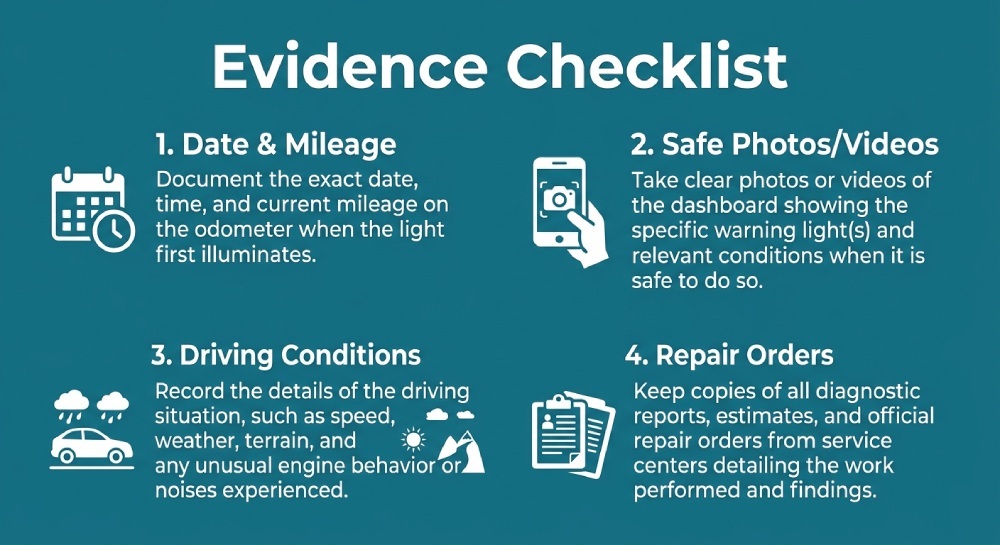
Create a record whenever the warning light appears. Include the date, approximate time, mileage, driving conditions, and any symptoms you notice.
For example, note whether the light appears during cold starts, long highway trips, heavy traffic, or acceleration. Record whether the vehicle loses power, hesitates, vibrates, shifts unexpectedly, or displays other warning messages.
Whenever it is safe to do so, take a photograph or video of the dashboard warning. Do not attempt to photograph the dashboard while driving.
Your records should include:
Dates and mileage for each occurrence.
Photographs or videos of the warning light.
Descriptions of unusual noises or driving behavior.
Dealership repair orders and inspection reports.
Copies of invoices, diagnostic results, and communications with the manufacturer.
These details can help technicians identify patterns that might otherwise be difficult to reproduce during a brief inspection.
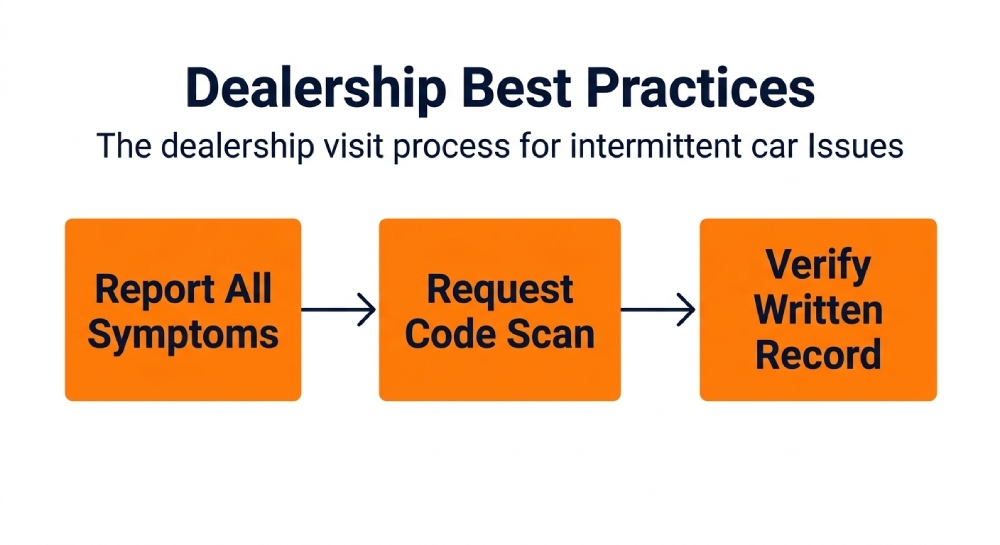
Ask the Dealership to Document the Complaint
Even if the warning light is off when you arrive, explain exactly what happened. Ask the service adviser to include your reported symptoms in the repair order.
A repair order should accurately reflect the complaint, the diagnostic procedures performed, any trouble codes found, and the results of the inspection. If the dealership cannot reproduce the problem, ask for that finding to be documented alongside your original complaint.
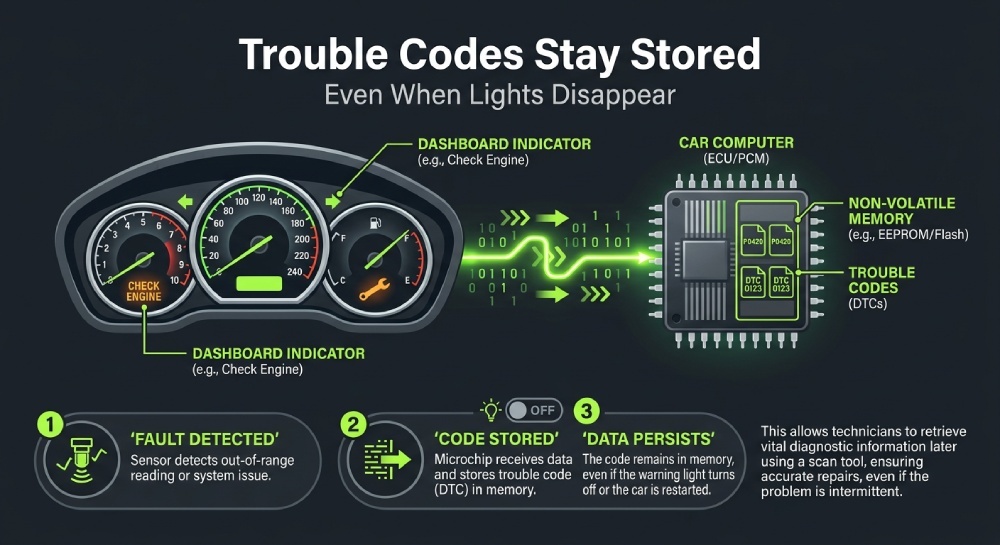
You can also ask whether the technician can review stored diagnostic trouble codes or relevant vehicle data, when available. Such information may help identify intermittent faults.
Do not assume that a visit has been properly documented just because you discussed the problem verbally. Review the paperwork before leaving and request corrections if important details are missing.
What to Do if the Dealership Cannot Find the Problem
Repeated visits without a clear diagnosis can leave vehicle owners uncertain about their next steps. Instead of waiting for the warning light to appear again without taking action, use each visit to build a more complete record.
Request Further Diagnostic Testing
Explain the conditions under which the warning light appears and ask whether additional testing is appropriate. Depending on the symptoms, the dealership may investigate wiring connections, sensors, software updates, electrical systems, or other components.
A second inspection may be useful if the issue continues and the initial testing does not identify a cause.
Can You File a Lemon Law Claim Without a Visible Warning Light?
A continuously illuminated dashboard warning light is not necessarily required to pursue a lemon law claim. Evidence of the underlying defect and its repair history may be more important than whether the warning appears during a particular inspection.
Useful evidence can include stored diagnostic codes, dealership records, manufacturer communications, photographs, videos, and consistent descriptions of recurring symptoms.
However, a claim may be more difficult to establish if there is no evidence connecting the warning light to an actual defect. The strength of the case depends on the available documentation and the applicable legal standards.
You should also avoid ignoring safety-related alerts. If a warning indicates a possible brake, steering, overheating, or other serious problem, stop driving when appropriate and follow the manufacturer's safety guidance or seek professional assistance.
Final Thoughts
A car can potentially qualify as a lemon even when its warning light disappears before every repair appointment. Intermittent problems can be difficult to diagnose, but their temporary disappearance does not necessarily mean the underlying defect has been fixed.
The most effective approach is to document every occurrence, obtain written repair records, request appropriate diagnostic testing, and understand the lemon law requirements in your state. If the manufacturer repeatedly fails to resolve a qualifying defect, you may have grounds to explore available legal remedies.
- lemon law
- car lemon law
- disappearing warning light
- intermittent car problems
- recurring vehicle defects
- lemon law claim
- vehicle repair attempts
- dashboard warning lights
- vehicle warranty
- car repair records
Think you've got a lemon?
Compare your situation to your state's requirements — and connect with a vetted lemon-law attorney for a free case review.